
大多数AI视频提示甚至在生成开始之前就失败了。
不是因为模型不好。
因为系统提示您:
“电影人穿梭于一座城市。逼真。4K。”
这描述了一种氛围。
它不会直接射击。
专业的人工智能电影制作提示应回答:
受众应该注意→什么?
→ 谁在画面中?
他们→ 到底在做什么?
摄像头→ 在哪里?我们使用→什么镜头?
演员表现→如何?
光线从→何而来?
对这个动作→有什么实际反应?
这张照片从→哪里开始和结束?
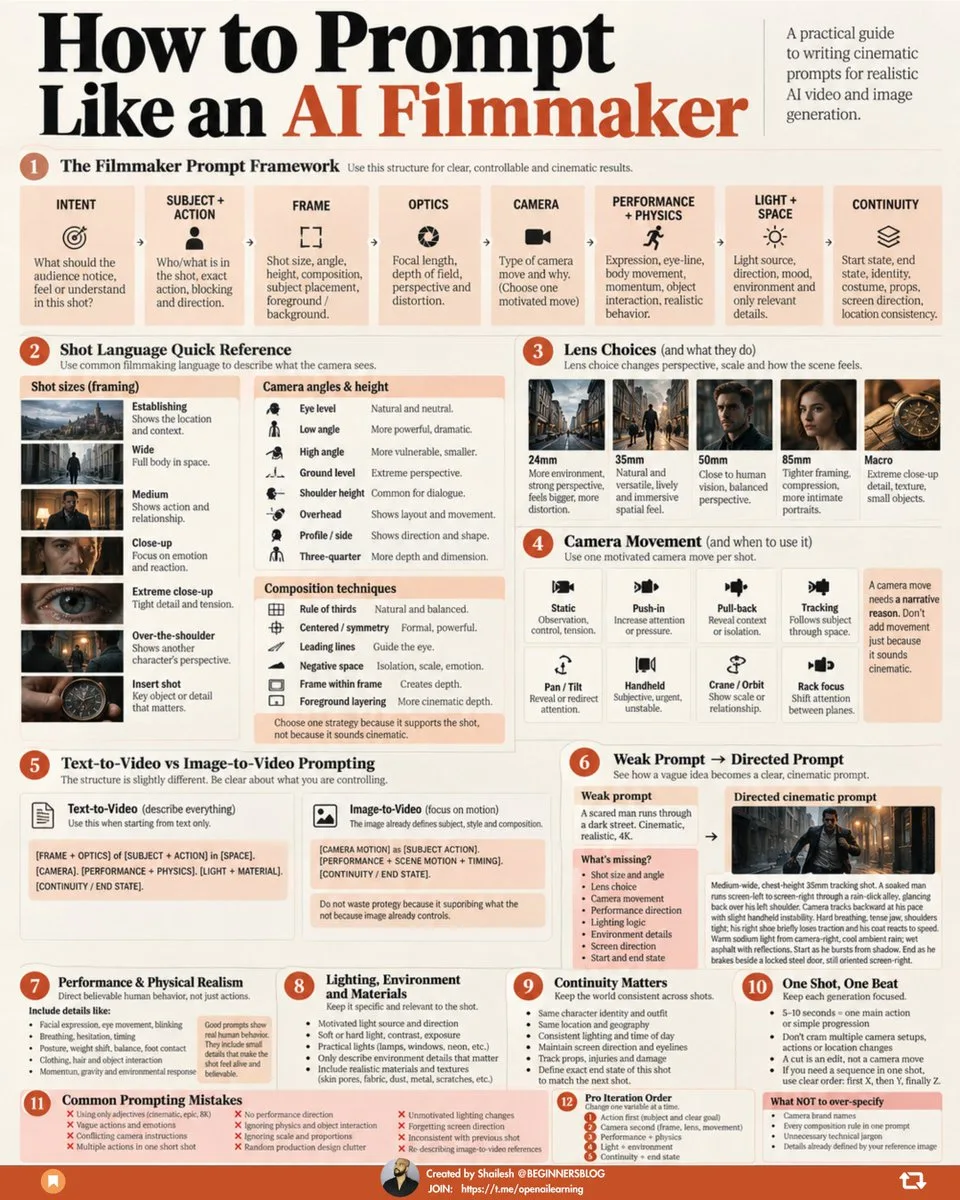
我使用的框架是:
意图→主题+动作→帧→光学→相机→性能+物理→光+空间→连续性
这实际上意味着什么。
1.意图
在写任何东西之前,先决定这张照片的作用。显示信息?
制造紧张气氛?
显示比例?
捕捉到反应?
如果拍摄没有目的,相机语言将不会保存它。
2.主题+操作
请勿写入:
“男人很害怕。”
写下行为:
“他在门口冻僵了,眼睛跟着声音,肩膀收紧,然后慢慢向后退。”
提示可见行为。
3.框架
定义相机看到的内容。→ 宽=地理位置和规模
→ 中=行动和关系
→ 特写=情绪和反应
→ 插入=重要细节
然后,仅在重要时添加角度、高度和构图。
4.光学
镜头选择会更改图像。
→ 24mm =环境、透视、速度
→ 35mm =自然空间能量
→ 50毫米=平衡的人类视角
→ 85毫米=压缩和亲密
→ 模板=触觉细节请勿添加“35毫米” ,因为它听起来像电影。
知道它为什么在那里。
5.相机
使用一种有动力的相机行为。
静态。
推入。
撤退。
跟踪。
手持设备。
平移。
倾斜。
起重机。
轨道。
摄像头应该移动,因为故事有所收获。
6.性能+物理
这就是许多AI镜头崩溃的地方。
直接:
眼→ 线
→ 呼吸
→ 犹豫
→ 姿势
→ 体重变化
→ 脚接触→ 动量
→ 服装反应
→ 对象交互
→ 平衡和恢复
“跑得快”是弱的方向。
“加速,失去牵引力半步,抓住平衡并继续移动”给出了模型的物理信息。
7.光线+空间
描述有动力的照明。
非:
“美丽的电影灯光。”
而是:“右侧摄像头发出温暖的钠光,凉爽的环境雨水填充,湿沥青上的硬反射。”
然后仅描述影响拍摄的环境细节。
8.连续性
每个镜头都存在于两个状态之间。
定义:
→ 起始位置
→ 屏幕方向
→ 服装
→ 道具
→ 受伤
→ 比例
→ 地理
→ 结束位置
在生成多个剪辑时,这一点更为重要。还有一个主要区别:
文本到视频和图像到视频的提示方式不应相同。
文本到视频需要更多的视觉信息。
图像到视频已经具有字符、构图、照明和环境。
所以不要再描述参考图像了。
提示动作:
→ 摄像头动作
→ 主体运动
→ 性能
→ 环境运动
→ timing
→ 连续性
最大的规则:一次拍摄,一次摄像头设置。一个清晰的节拍。
不要将五个动作、三个摄像头动作和两个情绪变化塞进8秒钟的一代。
PS:)关注我们,了解更多信息!
.
.
不是因为模型不好。
因为系统提示您:
“电影人穿梭于一座城市。逼真。4K。”
这描述了一种氛围。
它不会直接射击。
专业的人工智能电影制作提示应回答:
受众应该注意→什么?
→ 谁在画面中?
他们→ 到底在做什么?
摄像头→ 在哪里?我们使用→什么镜头?
演员表现→如何?
光线从→何而来?
对这个动作→有什么实际反应?
这张照片从→哪里开始和结束?
我使用的框架是:
意图→主题+动作→帧→光学→相机→性能+物理→光+空间→连续性
这实际上意味着什么。
1.意图
在写任何东西之前,先决定这张照片的作用。显示信息?
制造紧张气氛?
显示比例?
捕捉到反应?
如果拍摄没有目的,相机语言将不会保存它。
2.主题+操作
请勿写入:
“男人很害怕。”
写下行为:
“他在门口冻僵了,眼睛跟着声音,肩膀收紧,然后慢慢向后退。”
提示可见行为。
3.框架
定义相机看到的内容。→ 宽=地理位置和规模
→ 中=行动和关系
→ 特写=情绪和反应
→ 插入=重要细节
然后,仅在重要时添加角度、高度和构图。
4.光学
镜头选择会更改图像。
→ 24mm =环境、透视、速度
→ 35mm =自然空间能量
→ 50毫米=平衡的人类视角
→ 85毫米=压缩和亲密
→ 模板=触觉细节请勿添加“35毫米” ,因为它听起来像电影。
知道它为什么在那里。
5.相机
使用一种有动力的相机行为。
静态。
推入。
撤退。
跟踪。
手持设备。
平移。
倾斜。
起重机。
轨道。
摄像头应该移动,因为故事有所收获。
6.性能+物理
这就是许多AI镜头崩溃的地方。
直接:
眼→ 线
→ 呼吸
→ 犹豫
→ 姿势
→ 体重变化
→ 脚接触→ 动量
→ 服装反应
→ 对象交互
→ 平衡和恢复
“跑得快”是弱的方向。
“加速,失去牵引力半步,抓住平衡并继续移动”给出了模型的物理信息。
7.光线+空间
描述有动力的照明。
非:
“美丽的电影灯光。”
而是:“右侧摄像头发出温暖的钠光,凉爽的环境雨水填充,湿沥青上的硬反射。”
然后仅描述影响拍摄的环境细节。
8.连续性
每个镜头都存在于两个状态之间。
定义:
→ 起始位置
→ 屏幕方向
→ 服装
→ 道具
→ 受伤
→ 比例
→ 地理
→ 结束位置
在生成多个剪辑时,这一点更为重要。还有一个主要区别:
文本到视频和图像到视频的提示方式不应相同。
文本到视频需要更多的视觉信息。
图像到视频已经具有字符、构图、照明和环境。
所以不要再描述参考图像了。
提示动作:
→ 摄像头动作
→ 主体运动
→ 性能
→ 环境运动
→ timing
→ 连续性
最大的规则:一次拍摄,一次摄像头设置。一个清晰的节拍。
不要将五个动作、三个摄像头动作和两个情绪变化塞进8秒钟的一代。
PS:)关注我们,了解更多信息!
.
.
查看原文
原帖正文
Most AI video prompts fail before generation even starts.Not because the model is bad.Because the prompt says:
“Cinematic man running through a city. Realistic. 4K.”That describes a vibe.It does not direct a shot.A professional AI filmmaking prompt should answer:
→ What should the audience notice?
→ Who is in the frame?
→ What exactly are they doing?
→ Where is the camera?
→ What lens are we using?
→ How does the actor perform?
→ Where does the light come from?
→ What physically reacts to the action?
→ Where does this shot begin and end?The framework I use is:
INTENT → SUBJECT + ACTION → FRAME → OPTICS → CAMERA → PERFORMANCE + PHYSICS → LIGHT + SPACE → CONTINUITYHere is what that actually means.
1. INTENT
Before writing anything, decide what this shot is doing.
Reveal information?
Create tension?
Show scale?
Capture a reaction?
If the shot has no purpose, camera language will not save it.2. SUBJECT + ACTION
Do not write:
“Man is scared.”
Write the behavior:
“He freezes at the doorway, eyes tracking toward the sound, shoulders tightening before he slowly steps backward.”
Prompt visible behavior.3. FRAME
Define what the camera sees.
→ Wide = geography and scale
→ Medium = action and relationships
→ Close-up = emotion and reaction
→ Insert = important detail
Then add angle, height and composition only when they matter.4. OPTICS
Lens choice changes the image.
→ 24mm = environment, perspective, speed
→ 35mm = natural spatial energy
→ 50mm = balanced human perspective
→ 85mm = compression and intimacy
→ Macro = tactile detail
Do not add “35mm” because it sounds cinematic.
Know why it is there.5. CAMERA
Use one motivated camera behavior.
Static.
Push-in.
Pull-back.
Tracking.
Handheld.
Pan.
Tilt.
Crane.
Orbit.
The camera should move because the story gains something.6. PERFORMANCE + PHYSICS
This is where many AI shots collapse.
Direct:
→ eyelines
→ breathing
→ hesitation
→ posture
→ weight shifts
→ foot contact
→ momentum
→ clothing response
→ object interaction
→ balance and recovery
“Runs fast” is weak direction.
“Accelerates, loses traction for half a step, catches his balance and keeps moving” gives the model physical information.7. LIGHT + SPACE
Describe motivated lighting.
Not:
“Beautiful cinematic lighting.”
Instead:
“Warm sodium light from camera-right, cool ambient rain fill, hard reflections across wet asphalt.”
Then describe only the environmental details that affect the shot.8. CONTINUITY
Every shot exists between two states.
Define:
→ start position
→ screen direction
→ costume
→ props
→ injuries
→ scale
→ geography
→ end position
This matters even more when generating multiple clips.And one major distinction:
Text-to-video and image-to-video should not be prompted the same way.
Text-to-video needs more visual information.
Image-to-video already has the character, composition, lighting and environment.
So stop describing the reference image again.
Prompt the motion:
→ camera motion
→ subject motion
→ performance
→ environmental motion
→ timing
→ continuityThe biggest rule:
One shot. One camera setup. One clear beat.
Do not cram five actions, three camera moves and two emotional changes into an 8-second generation.PS:) Follow for more!
.
.
“Cinematic man running through a city. Realistic. 4K.”That describes a vibe.It does not direct a shot.A professional AI filmmaking prompt should answer:
→ What should the audience notice?
→ Who is in the frame?
→ What exactly are they doing?
→ Where is the camera?
→ What lens are we using?
→ How does the actor perform?
→ Where does the light come from?
→ What physically reacts to the action?
→ Where does this shot begin and end?The framework I use is:
INTENT → SUBJECT + ACTION → FRAME → OPTICS → CAMERA → PERFORMANCE + PHYSICS → LIGHT + SPACE → CONTINUITYHere is what that actually means.
1. INTENT
Before writing anything, decide what this shot is doing.
Reveal information?
Create tension?
Show scale?
Capture a reaction?
If the shot has no purpose, camera language will not save it.2. SUBJECT + ACTION
Do not write:
“Man is scared.”
Write the behavior:
“He freezes at the doorway, eyes tracking toward the sound, shoulders tightening before he slowly steps backward.”
Prompt visible behavior.3. FRAME
Define what the camera sees.
→ Wide = geography and scale
→ Medium = action and relationships
→ Close-up = emotion and reaction
→ Insert = important detail
Then add angle, height and composition only when they matter.4. OPTICS
Lens choice changes the image.
→ 24mm = environment, perspective, speed
→ 35mm = natural spatial energy
→ 50mm = balanced human perspective
→ 85mm = compression and intimacy
→ Macro = tactile detail
Do not add “35mm” because it sounds cinematic.
Know why it is there.5. CAMERA
Use one motivated camera behavior.
Static.
Push-in.
Pull-back.
Tracking.
Handheld.
Pan.
Tilt.
Crane.
Orbit.
The camera should move because the story gains something.6. PERFORMANCE + PHYSICS
This is where many AI shots collapse.
Direct:
→ eyelines
→ breathing
→ hesitation
→ posture
→ weight shifts
→ foot contact
→ momentum
→ clothing response
→ object interaction
→ balance and recovery
“Runs fast” is weak direction.
“Accelerates, loses traction for half a step, catches his balance and keeps moving” gives the model physical information.7. LIGHT + SPACE
Describe motivated lighting.
Not:
“Beautiful cinematic lighting.”
Instead:
“Warm sodium light from camera-right, cool ambient rain fill, hard reflections across wet asphalt.”
Then describe only the environmental details that affect the shot.8. CONTINUITY
Every shot exists between two states.
Define:
→ start position
→ screen direction
→ costume
→ props
→ injuries
→ scale
→ geography
→ end position
This matters even more when generating multiple clips.And one major distinction:
Text-to-video and image-to-video should not be prompted the same way.
Text-to-video needs more visual information.
Image-to-video already has the character, composition, lighting and environment.
So stop describing the reference image again.
Prompt the motion:
→ camera motion
→ subject motion
→ performance
→ environmental motion
→ timing
→ continuityThe biggest rule:
One shot. One camera setup. One clear beat.
Do not cram five actions, three camera moves and two emotional changes into an 8-second generation.PS:) Follow for more!
.
.
引用自 X
原帖地址:https://x.com/i/status/2105685837812007258
原帖:
本站媒体副本
0 条评论
登录后可以参与讨论。
成员登录还没有评论。第一条认真回应会很重要。