
MEPPP 热点收录
@meppp_hot
收录
原帖正文
AI制药赛道(AIDD)的"瓶颈交易"正在成形,Freda Duan这篇推文值得好好看看,梳理下要点。
前沿AI实验室的集体入场是最显著的信号:1)Anthropic组建了专属生命科学研究团队并建立湿实验室;
2)OpenAI 建立了专为生物学和药物发现设计的 GPT-Rosalind 模型族;
3)字节跳动旗下独立运营的 Anew Labs 已拥有内部药物研发库;
4)同构实验室(Isomorphic Labs)则明确表示将把 AI 设计的药物推进人体临床试验。与此同时供给端的信号也很清晰:
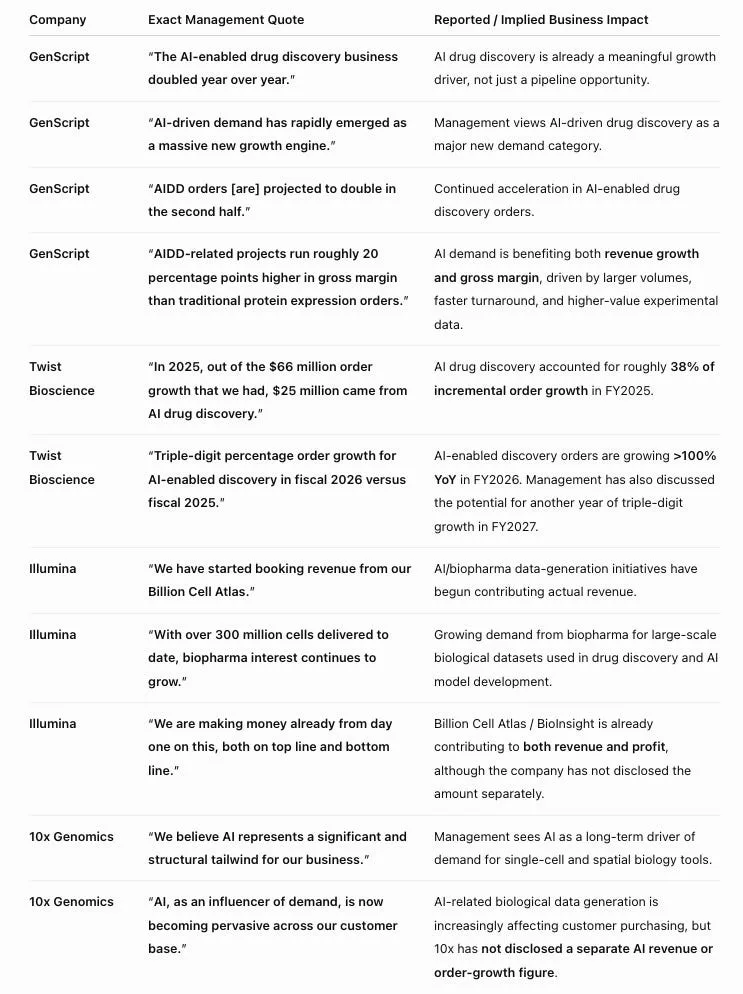
1)DNA 合成商拓斯达生物(Twist Bioscience,TWST)预计2026财年和2027财年的AI药物发现订单将连续实现三位数百分比增长;
2)金斯瑞(GenScript)的 AI 药物发现业务在 2026 财年上半年同比翻倍,渠道调研显示其实际验证产能已达每日约8,000个设计,并有望在 2026 年底前提升至 16,000 个。AI制药正在形成类似半导体"瓶颈交易"的结构性机会。核心逻辑在于:AI让失败实验也变成有价值的训练数据,湿实验室正从"造药"转型为"造数据",DNA合成、蛋白生产、CRO或成最先受益的"卖铲人"。在AI制药领域,瓶颈同样在沿产业链向下传递:AI模型产生设计→DNA合成→蛋白生产→实验验证→临床前测试,每个环节都可能成为下一个受益节点。洛杉矶加州大学教授Quanquan Gu认为:生物学可能成为AI下一个递归自我改进的前沿——在计算机中设计,在实验室中测试,将实验反馈转化为半合成训练数据,改进模型,周而复始。看来AI-bio值得好好研究下了。
前沿AI实验室的集体入场是最显著的信号:1)Anthropic组建了专属生命科学研究团队并建立湿实验室;
2)OpenAI 建立了专为生物学和药物发现设计的 GPT-Rosalind 模型族;
3)字节跳动旗下独立运营的 Anew Labs 已拥有内部药物研发库;
4)同构实验室(Isomorphic Labs)则明确表示将把 AI 设计的药物推进人体临床试验。与此同时供给端的信号也很清晰:
1)DNA 合成商拓斯达生物(Twist Bioscience,TWST)预计2026财年和2027财年的AI药物发现订单将连续实现三位数百分比增长;
2)金斯瑞(GenScript)的 AI 药物发现业务在 2026 财年上半年同比翻倍,渠道调研显示其实际验证产能已达每日约8,000个设计,并有望在 2026 年底前提升至 16,000 个。AI制药正在形成类似半导体"瓶颈交易"的结构性机会。核心逻辑在于:AI让失败实验也变成有价值的训练数据,湿实验室正从"造药"转型为"造数据",DNA合成、蛋白生产、CRO或成最先受益的"卖铲人"。在AI制药领域,瓶颈同样在沿产业链向下传递:AI模型产生设计→DNA合成→蛋白生产→实验验证→临床前测试,每个环节都可能成为下一个受益节点。洛杉矶加州大学教授Quanquan Gu认为:生物学可能成为AI下一个递归自我改进的前沿——在计算机中设计,在实验室中测试,将实验反馈转化为半合成训练数据,改进模型,周而复始。看来AI-bio值得好好研究下了。
引用自 X
原帖地址:https://x.com/i/status/2107092468756062686
原帖:
当一个行业开始经历真正的制度性变革时,我会感到兴奋。AI药物发现(“AIDD”)似乎正经历着这样的时刻。两件事正在发生:
1/ 上游:前沿的AI实验室纷纷涌入。
2/ 下游:供应链显然在移动。供应链检查显示,上游的发现和早期临床前研究的筛选和挖掘已经开始感受到实验量增加的影响。该系列中的名称包括 $TWST。 @GenScript , $ILMN , $TXG , 供应商和 CROs。$TWST 预计在 FY26 中,AI 使药物发现订单将实现三位数的百分比增长,而在 FY27 中,还将实现两位数的订单增长。@GenScript为什么AI驱动了更多的实验室需求?1. 人工智能几乎将假设生成的成本降为零 → 球门射门次数大幅增加。
瓶颈在于从专家驱动的设计转向生物验证。2. 人工智能模型需要持续的实验反馈 —— 无论是好的还是坏的数据都是有用的。
传统上,只有最高信心的A+候选人才会被推入昂贵的验证。有了人工智能,即使是B/C级别的候选人也能变得有价值,因为失败的实验可以生成训练数据。@GenScript 它表示其序列到绑定工作流程可以在4到7天内返回数据,并指出更快的周期时间很重要,因为AI模型依赖于连续的实验反馈。@Anthropic 这是一个干净的例子。 @claudeai 设计了1,320种蛋白质结合剂。 @adaptyvbio 将这些数字序列转换为DNA,表达蛋白质,并测试结合。只有354个确实结合。而966个失败的实验并不是浪费的。它们是有用的负标签:那些没有表达的,那些没有结合的,那些结合力差的。这些结果帮助训练下一个模型迭代。 @GenScript 越来越多地看起来像生物数据工厂。$TWST明确提到,从AI设计的序列中生成模型准备的数据。在某些工作流程中,客户可能更关心从物理蛋白质中获得结果,而不是从模型中获得结构化的实验结果。传统药物发现的问题是:“候选X是否有效?”人工智能药物发现也问:“这个实验能教会模型什么呢?”AIDD的TAM如果AI只是更好的研发工具,那么相关的支出池就是全球制药行业的300亿至400亿美元的年度研发支出。如果AI有意义地增加了可行的药物项目数量,那么机会就更大,因为这扩大了DNA合成、蛋白质生产、测试和临床前工作的下游需求。短期内,我们也可以从AI公司支出中估算需求。 Anthropic 2026年,该业务的年度收入(ARR)将达到80亿美元,而AIDD(人工智能驱动的决策)的支出仅为1%,这本身就意味着每年约8亿美元的投资。---
交易设置这是一个可以长期发展的交易。直到2028年或之后的I/II期结果,它才可能真正停止工作。它闻起来就像我们在半导体中刚刚看到的瓶颈交易:GPU → HBM → 网络 → 功率/冷却。在生物学中,它基本上遵循了药物发现过程的下游阶段:AI模型 → 设计 → DNA/蛋白质 → 测试 → 临床前能力。在上游筛选和挖掘之后,动物测试可能会成为下一个瓶颈。猴的价格已经接近历史高位,CRO(合同研究组织)的产能紧张。AIDD(人工智能驱动的药物发现)的推动更多候选药物进入临床前开发阶段只会增加需求。但临床试验仍然是瓶颈?
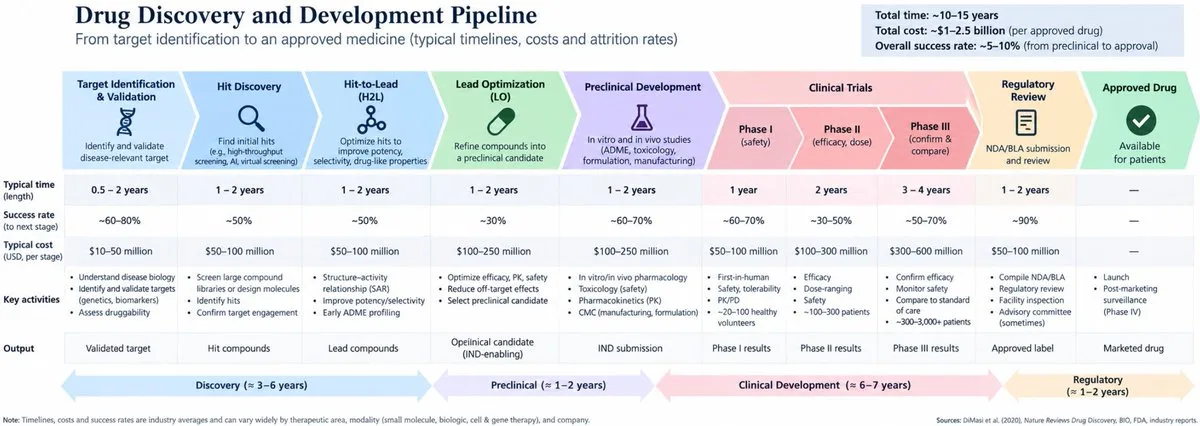
这是我不断回到的最大阻力。无论发现的速度如何,药物仍然需要通过预临床 → 一期 → 二期 → 三期 → 批准。你仍然需要患者、时间、资金。但这并不意味着瓶颈交易不会发挥作用。更多可行的候选人——尤其是成功率更高的——在整个开发过程中仍然意味着更多的需求。谁知道:临床试验本身可能会最终通过AI优化。短期内,如果实验预算停止增长、AI生成的设计无法转化为有用的实验室成果,或者产能赶超,那么“拣石子儿”和“挖土机”交易将破裂。长期来看,如果AI药物在发现阶段和I期临床试验中看起来很好,但在II期/III期临床试验中表现不佳,那么这个论点就会崩溃。这就是为什么II期如此重要。2026-2027年:第一批基于Isomorphic设计的药物进入人体临床试验;更多AI原生程序进入IND可开发阶段/毒理学研究。2028-2030年:临床试验结果开始告诉我们,AI设计的药物是否真的比传统药物更好。来吧,所有的“瓶颈兄弟”! @jukan05 @zephyr_z9 @aleabitoreddit @ParadisLabs+++
更全面的分析: https://robonomics.substack.com/p/ai-drug-discovery-is-becoming-a-bottleneck?r=3hcp4&utm_campaign=post-expanded-share&utm_medium=web
1/ 上游:前沿的AI实验室纷纷涌入。
2/ 下游:供应链显然在移动。供应链检查显示,上游的发现和早期临床前研究的筛选和挖掘已经开始感受到实验量增加的影响。该系列中的名称包括 $TWST。 @GenScript , $ILMN , $TXG , 供应商和 CROs。$TWST 预计在 FY26 中,AI 使药物发现订单将实现三位数的百分比增长,而在 FY27 中,还将实现两位数的订单增长。@GenScript为什么AI驱动了更多的实验室需求?1. 人工智能几乎将假设生成的成本降为零 → 球门射门次数大幅增加。
瓶颈在于从专家驱动的设计转向生物验证。2. 人工智能模型需要持续的实验反馈 —— 无论是好的还是坏的数据都是有用的。
传统上,只有最高信心的A+候选人才会被推入昂贵的验证。有了人工智能,即使是B/C级别的候选人也能变得有价值,因为失败的实验可以生成训练数据。@GenScript 它表示其序列到绑定工作流程可以在4到7天内返回数据,并指出更快的周期时间很重要,因为AI模型依赖于连续的实验反馈。@Anthropic 这是一个干净的例子。 @claudeai 设计了1,320种蛋白质结合剂。 @adaptyvbio 将这些数字序列转换为DNA,表达蛋白质,并测试结合。只有354个确实结合。而966个失败的实验并不是浪费的。它们是有用的负标签:那些没有表达的,那些没有结合的,那些结合力差的。这些结果帮助训练下一个模型迭代。 @GenScript 越来越多地看起来像生物数据工厂。$TWST明确提到,从AI设计的序列中生成模型准备的数据。在某些工作流程中,客户可能更关心从物理蛋白质中获得结果,而不是从模型中获得结构化的实验结果。传统药物发现的问题是:“候选X是否有效?”人工智能药物发现也问:“这个实验能教会模型什么呢?”AIDD的TAM如果AI只是更好的研发工具,那么相关的支出池就是全球制药行业的300亿至400亿美元的年度研发支出。如果AI有意义地增加了可行的药物项目数量,那么机会就更大,因为这扩大了DNA合成、蛋白质生产、测试和临床前工作的下游需求。短期内,我们也可以从AI公司支出中估算需求。 Anthropic 2026年,该业务的年度收入(ARR)将达到80亿美元,而AIDD(人工智能驱动的决策)的支出仅为1%,这本身就意味着每年约8亿美元的投资。---
交易设置这是一个可以长期发展的交易。直到2028年或之后的I/II期结果,它才可能真正停止工作。它闻起来就像我们在半导体中刚刚看到的瓶颈交易:GPU → HBM → 网络 → 功率/冷却。在生物学中,它基本上遵循了药物发现过程的下游阶段:AI模型 → 设计 → DNA/蛋白质 → 测试 → 临床前能力。在上游筛选和挖掘之后,动物测试可能会成为下一个瓶颈。猴的价格已经接近历史高位,CRO(合同研究组织)的产能紧张。AIDD(人工智能驱动的药物发现)的推动更多候选药物进入临床前开发阶段只会增加需求。但临床试验仍然是瓶颈?
这是我不断回到的最大阻力。无论发现的速度如何,药物仍然需要通过预临床 → 一期 → 二期 → 三期 → 批准。你仍然需要患者、时间、资金。但这并不意味着瓶颈交易不会发挥作用。更多可行的候选人——尤其是成功率更高的——在整个开发过程中仍然意味着更多的需求。谁知道:临床试验本身可能会最终通过AI优化。短期内,如果实验预算停止增长、AI生成的设计无法转化为有用的实验室成果,或者产能赶超,那么“拣石子儿”和“挖土机”交易将破裂。长期来看,如果AI药物在发现阶段和I期临床试验中看起来很好,但在II期/III期临床试验中表现不佳,那么这个论点就会崩溃。这就是为什么II期如此重要。2026-2027年:第一批基于Isomorphic设计的药物进入人体临床试验;更多AI原生程序进入IND可开发阶段/毒理学研究。2028-2030年:临床试验结果开始告诉我们,AI设计的药物是否真的比传统药物更好。来吧,所有的“瓶颈兄弟”! @jukan05 @zephyr_z9 @aleabitoreddit @ParadisLabs+++
更全面的分析: https://robonomics.substack.com/p/ai-drug-discovery-is-becoming-a-bottleneck?r=3hcp4&utm_campaign=post-expanded-share&utm_medium=web
查看引用原文
AI Drug Discovery Is Becoming a Bottleneck TradeI get excited when an industry starts going through a real regime change. AI drug discovery (“AIDD”) increasingly looks like one of those moments.Two things are happening:
1/ Upstream: the frontier AI labs are piling in.
2/ Downstream: The supply chain is clearly moving.Supply-chain checks suggest the upstream picks-and-shovels of discovery and early preclinical R&D are starting to feel the increase in experimental volume.DNA → protein → assays → sequencing → automation → preclinical testingNames across that stack include $TWST , @GenScript , $ILMN , $TXG , lab-automation vendors and CROs.$TWST expects triple-digit percentage growth in AI-enabled drug-discovery orders in FY26, and another year of triple-digit order growth in FY27.@GenScript's AIDD business doubled YoY in 1H26. Its current platform advertises industrial-scale validation of 4,000+ designs/day, with integrated sequence-to-data workflows. Our channel checks suggest the ramp is moving even faster: roughly 8,000 designs/day currently, with a path toward ~16,000/day by YE26.---
Why does AI drive more wet-lab demand?1/ AI makes hypothesis generation almost free → way more shots on goal.
The bottleneck is moving from expert-driven design to biological validation.2/ AI models need continuous experimental feedback — and both good and bad data are useful.
Traditionally, only the highest-conviction A+ candidates might get pushed into expensive validation. With AI, even the B/C candidates can be valuable because failed experiments generate training data.@GenScript has said its sequence-to-binding workflow can return data in 4–7 days, and that faster cycle times matter because AI models depend on continuous experimental feedback.@Anthropic is a clean example. @claudeai designed 1,320 protein binders. @adaptyvbio converted those digital sequences into DNA, expressed the proteins and tested binding. Only 354 actually bound. And the 966 failures are not wasted. They are useful negative labels: what does not express, what does not bind, what has poor affinity. Those results help train the next model iteration.3/ Wet labs are no longer just making drugs. They are making training data.
$TWST / @GenScript increasingly look like biological data foundries.$TWST explicitly talks about generating model-ready data from AI-designed sequences. In some workflows, the customer may care less about receiving the physical protein than about getting structured experimental results back into the model.Traditional drug discovery asks: “Does candidate X work?”AI drug discovery also asks: “What can this experiment teach the model?”---
TAM of AIDDIf AI is simply a better R&D tool, the relevant spending pool is the $300–400B of annual global pharma R&D. If AI meaningfully increases the number of viable drug programs, the opportunity is larger because it expands downstream demand for DNA synthesis, protein production, assays, and preclinical work.Near term, we can also size demand from AI-company spending. If Anthropic reaches $80B of ARR in 2026 and spends just 1% on AIDD, that alone would imply ~$800M of annual investment.---
Trade setupThis is a trade that could have long legs. It’s hard to really stop working until PhaseI/II results (2028+)It smells a lot like the bottleneck trade we just saw in semis: GPUs → HBM → networking → power/cooling. In biology, It basically follows the drug discovery process downstream: AI models → designs → DNA/protein → assays → preclinical capacity.After the upstream picks-and-shovels, animal testing could become the next bottleneck. Monkey prices are already near prior highs and CRO capacity is tight. AIDD pushing more candidates into preclinical development would only add demand.?? But clinical trials are still the bottleneck?
This is the biggest pushback I keep coming back to. No matter how fast discovery becomes, drugs still need to go through preclinical → Phase I → Phase II → Phase III → approval. You still need patients, time and capital.But that doesn’t mean the bottleneck trade won’t work. More viable candidates — especially with higher success rates — still means more demand throughout the development process.And who knows: clinical trials themselves may eventually be optimized by AI.?? What breaks the trade?
Near term, the picks-and-shovels trade breaks if experimental budgets stop growing, AI-generated designs don’t translate into useful wet-lab hits, or capacity catches up too quickly.Longer term, the thesis breaks if AI drugs look great in discovery / Phase I but fail at normal rates in Phase II/III. That is why Phase II matters so much.?? Milestones
Late 2026–2027: first Isomorphic-designed drugs enter human trials; more AI-native programs move into IND-enabling work / tox.2028–2030: clinical trial results start telling us whether AI-designed drugs actually perform better than conventional drugs.Calling all the "bottleneck bros". :) @jukan05 @zephyr_z9 @aleabitoreddit @ParadisLabs+++
More comprehensive analysis: https://robonomics.substack.com/p/ai-drug-discovery-is-becoming-a-bottleneck?r=3hcp4&utm_campaign=post-expanded-share&utm_medium=web
1/ Upstream: the frontier AI labs are piling in.
2/ Downstream: The supply chain is clearly moving.Supply-chain checks suggest the upstream picks-and-shovels of discovery and early preclinical R&D are starting to feel the increase in experimental volume.DNA → protein → assays → sequencing → automation → preclinical testingNames across that stack include $TWST , @GenScript , $ILMN , $TXG , lab-automation vendors and CROs.$TWST expects triple-digit percentage growth in AI-enabled drug-discovery orders in FY26, and another year of triple-digit order growth in FY27.@GenScript's AIDD business doubled YoY in 1H26. Its current platform advertises industrial-scale validation of 4,000+ designs/day, with integrated sequence-to-data workflows. Our channel checks suggest the ramp is moving even faster: roughly 8,000 designs/day currently, with a path toward ~16,000/day by YE26.---
Why does AI drive more wet-lab demand?1/ AI makes hypothesis generation almost free → way more shots on goal.
The bottleneck is moving from expert-driven design to biological validation.2/ AI models need continuous experimental feedback — and both good and bad data are useful.
Traditionally, only the highest-conviction A+ candidates might get pushed into expensive validation. With AI, even the B/C candidates can be valuable because failed experiments generate training data.@GenScript has said its sequence-to-binding workflow can return data in 4–7 days, and that faster cycle times matter because AI models depend on continuous experimental feedback.@Anthropic is a clean example. @claudeai designed 1,320 protein binders. @adaptyvbio converted those digital sequences into DNA, expressed the proteins and tested binding. Only 354 actually bound. And the 966 failures are not wasted. They are useful negative labels: what does not express, what does not bind, what has poor affinity. Those results help train the next model iteration.3/ Wet labs are no longer just making drugs. They are making training data.
$TWST / @GenScript increasingly look like biological data foundries.$TWST explicitly talks about generating model-ready data from AI-designed sequences. In some workflows, the customer may care less about receiving the physical protein than about getting structured experimental results back into the model.Traditional drug discovery asks: “Does candidate X work?”AI drug discovery also asks: “What can this experiment teach the model?”---
TAM of AIDDIf AI is simply a better R&D tool, the relevant spending pool is the $300–400B of annual global pharma R&D. If AI meaningfully increases the number of viable drug programs, the opportunity is larger because it expands downstream demand for DNA synthesis, protein production, assays, and preclinical work.Near term, we can also size demand from AI-company spending. If Anthropic reaches $80B of ARR in 2026 and spends just 1% on AIDD, that alone would imply ~$800M of annual investment.---
Trade setupThis is a trade that could have long legs. It’s hard to really stop working until PhaseI/II results (2028+)It smells a lot like the bottleneck trade we just saw in semis: GPUs → HBM → networking → power/cooling. In biology, It basically follows the drug discovery process downstream: AI models → designs → DNA/protein → assays → preclinical capacity.After the upstream picks-and-shovels, animal testing could become the next bottleneck. Monkey prices are already near prior highs and CRO capacity is tight. AIDD pushing more candidates into preclinical development would only add demand.?? But clinical trials are still the bottleneck?
This is the biggest pushback I keep coming back to. No matter how fast discovery becomes, drugs still need to go through preclinical → Phase I → Phase II → Phase III → approval. You still need patients, time and capital.But that doesn’t mean the bottleneck trade won’t work. More viable candidates — especially with higher success rates — still means more demand throughout the development process.And who knows: clinical trials themselves may eventually be optimized by AI.?? What breaks the trade?
Near term, the picks-and-shovels trade breaks if experimental budgets stop growing, AI-generated designs don’t translate into useful wet-lab hits, or capacity catches up too quickly.Longer term, the thesis breaks if AI drugs look great in discovery / Phase I but fail at normal rates in Phase II/III. That is why Phase II matters so much.?? Milestones
Late 2026–2027: first Isomorphic-designed drugs enter human trials; more AI-native programs move into IND-enabling work / tox.2028–2030: clinical trial results start telling us whether AI-designed drugs actually perform better than conventional drugs.Calling all the "bottleneck bros". :) @jukan05 @zephyr_z9 @aleabitoreddit @ParadisLabs+++
More comprehensive analysis: https://robonomics.substack.com/p/ai-drug-discovery-is-becoming-a-bottleneck?r=3hcp4&utm_campaign=post-expanded-share&utm_medium=web
0 条评论
登录后可以参与讨论。
成员登录还没有评论。第一条认真回应会很重要。